_edited_e.png)

———— A REMARKABLE HISTORY
Two Thousand Years
on the Shore of the Kinneret
Tiberias is one of the most storied cities in all of Jewish history. This is where the Sanhedrin found its final home, where the Jerusalem Talmud was sealed, where the Hebrew language was codified for all time — and where Maimonides was laid to rest. To understand the Maimonides Heritage Center is to understand Tiberias itself.
17 BCE
CITY OF TIBERIAS FOUNDED
400 BCE
JERUSALEM TALMUD SEALED HERE
1204 CE
RAMBAM BURIED IN TIBERIAS
2004 CE
MHC FOUNDED
I
PART ONE
The History of Tiberias
———— ANCIENT CITY, ETERNAL SIGNIFICANCE
A City Built for History
Built by Herod Antipas and named for the Roman Emperor Tiberius, this city rose on the shores of the Sea of Galilee — more than 600 feet below sea level — around seventeen natural hot springs that had drawn visitors from across the ancient world for generations. But Tiberias was not destined to remain a Roman resort.
As the Great Jewish Revolt shook Jerusalem, the Sanhedrin — the supreme court of Jewish law — fled the holy city and, after ten way stations, came to rest permanently in Tiberias. With it came the full weight of Jewish intellectual and spiritual life. For more than a thousand years, Tiberias would serve as the beating heart of Jewish civilization.
"It is said that the redemption of the Jewish people and the reinstitution of the Sanhedrin will take place in Tiberias."
TALMUD BAVLI — ROSH HASHANAH 31A
200 CE
Rabbi Yehudah HaNasi compiles the Oral Law in Tiberias — a cornerstone of Jewish life to this day.
MISHNAH RECORDED
400 CE
The Talmud Yerushalmi is compiled and closed in Tiberias — one of the greatest achievements in Jewish literary history.
JERUSALEM TALMUD SEALED
150 CE
The supreme Jewish court settles in Tiberias, transforming it into the center of Jewish religious authority.
JERUSALEM TALMUD SEALED
17 BCE
The thermal springs that first drew the ancient world to Tiberias continue to flow to this day.
NATURAL HOT SPRINGS


——— TWO MILLENNIA OF HISTORY
Tiberias Through the Ages
Few cities have played as sustained a role in Jewish civilization as Tiberias. From Roman resort to rabbinic capital, from Crusader stronghold to modern pilgrimage site, the city has witnessed — and shaped — the full arc of Jewish history.
1099–1187 CE
The Crusader Era
Tiberias becomes the capital of the Crusader Principality of Galilee. The Battle of Hattin in 1187, fought 10 km from the city, marks the decisive defeat of Crusader forces by Saladin — a turning point in the history of the entire region.
1204 CE
Maimonides Is Buried in Tiberias
Moses ben Maimon — the Rambam — passes away in Cairo. In accordance with his wishes, his remains are brought to Tiberias, where he is buried on Ben Zakai Street. The tradition locating his burial here is documented within 54 years of his death — among the best-attested burial sites of any medieval sage — and draws pilgrims and scholars to Tiberias to this day.
8th–10th Cent. CE
The Tiberian Masoretes Flourish
A community of scholars in Tiberias codifies the vowels, cantillation marks, and oral traditions of Biblical Hebrew. Their system is still used in every printed Hebrew text in the world today. Their crowning achievement — the Aleppo Codex — is the oldest and most authoritative Hebrew Bible manuscript in existence.
400 CE
The Jerusalem Talmud Is Sealed
The Talmud Yerushalmi is compiled and closed in Tiberias — one of the two great pillars of classical Jewish scholarship, produced nowhere else on earth.
200 CE
The Mishnah Is Written
Rabbi Yehudah HaNasi compiles and records the Mishnah in Tiberias — the foundational text of the Oral Law and the basis of all subsequent Jewish legal literature.
150 CE
The Sanhedrin Settles Here
Following the Great Jewish Revolt, the Sanhedrin establishes its permanent home in Tiberias — making the city the center of Jewish religious and legal authority for generations.
17 BCE
Tiberias Founded
Herod Antipas builds the city on the western shore of the Sea of Galilee. Its natural hot springs and mild climate attract visitors from across the ancient world.

———— THE RAMBAM'S BURIAL SITE
How Do We Know Maimonides Is Buried Here?
Unlike many ancient burial traditions that rest on uncertain ground, the evidence for Maimonides' burial in Tiberias is unusually strong. The earliest written record identifying his grave here dates to 1258 — only 54 years after his death — and the tradition has never been seriously contested.
The Rambam was first interred in Cairo immediately after his death, until arrangements could be made to transport his remains to the Land of Israel — a practice common among medieval Egyptian Jews. A 17th-century Egyptian scholar, Rabbi Yoseph Sambori, recorded this precisely: "Rabbi Moshe Ben Maimon was first buried alongside his study house until his remains were transported to Tiberias." The Jewish community of Egypt, which maintained meticulous burial records across centuries, has never claimed he was permanently buried there.
About a century ago, the gravestone of Rabbi David — Maimonides' own grandson — was discovered adjacent to the Rambam's grave on the grounds of what is today the Maimonides Heritage Center. Rabbi David had lived for years in Israel, returned to Egypt where he died, and was brought back to Tiberias to rest beside his grandfather — a final testament to the enduring sanctity of this place.
THE HISTORICAL RECORD
1258 CE
In his meticulous record of travels through Israel, he lists those buried in Tiberias: "Rabbi Moshe Ben Maimon, their memory should be a blessing."
RABBI YA'ACOV OF PARIS — ELEH MASA'OT
14th Cent. CE
After meeting the Rambam's descendants in Egypt — and hearing no claim of Egyptian burial — he writes that among the great sages buried in Tiberias is "HaRambam."
RABBI ESHTORI FARHI — KAPHTOR VAFERAH
1288 CE
Rabbis from Damascus, Baghdad, and Tzfat gather at Maimonides' grave to issue a formal declaration — placing the site unmistakably in northern Israel, near Tzfat and Acco.
THE DAMASCUS DECLARATION
17th Cent. CE
Records the complete tradition: the Rambam was buried temporarily in Egypt, then transported to Tiberias. No community anywhere has ever maintained a conflicting claim.
RABBI YOSEPH SAMBORI — EGYPTIAN SCHOLAR

———— THE KINNERET
The Sea of Galilee
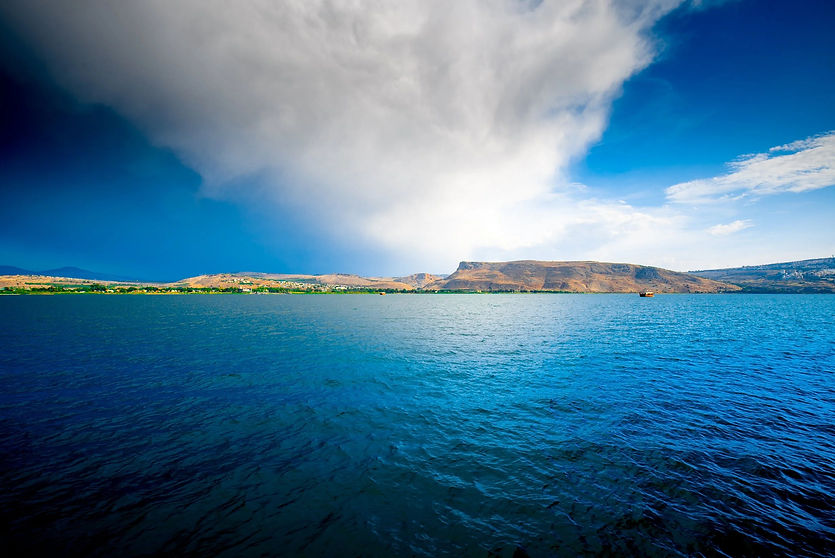
Tiberias sits on the shores of the Kinneret — the Sea of Galilee — whose name may derive from its harp-like shape, kinor in Hebrew. It is the primary source of fresh water for the entire State of Israel, and its waters appear throughout scripture.
For millennia, this inland sea has nourished the land and sustained its people. Its shores served as the backdrop for some of history's most consequential moments — and its beauty has drawn pilgrims, scholars, and seekers to Tiberias in every era of human history.
BELOW SEA LEVEL
650 ft
LENGTH OF THE LAKE
14 mi
WIDEST POINT
7.5 mi
SHORELINE CIRCUMFERENCE
32 mi
———— TIBERIAS, THE MESORAH & MAIMONIDES
The Language of Every Torah Scroll
The connection between Tiberias and Maimonides runs far deeper than burial. Between the 8th and 10th centuries, a community of scholars known as the Masoretes flourished in Tiberias, systematically codifying the vowels, cantillation marks, and oral traditions of Biblical Hebrew. Their achievement had no parallel anywhere in the Jewish world.
Their crowning work — the Aleppo Codex, produced by the master Masorete Aaron ben Moshe ben Asher — is the oldest and most accurate complete manuscript of the Hebrew Bible in existence. Across more than two million orthographic symbols, its errors number only a handful. It is now preserved at the Shrine of the Book in Jerusalem.
Maimonides himself held the Aleppo Codex in Cairo, where it had been ransomed from Crusader forces. He declared it the authoritative reference for writing Torah scrolls — a ruling that standardized the spelling and section-breaks of every Torah scroll in every Jewish community in the world, to this day. The vowels in every Hebrew text printed today are the legacy of Tiberias, transmitted to the world through Maimonides.
"The book upon which I have relied in these matters… was proofread by Ben Asher, who devoted years of meticulous attention to it. And I relied on it for the Torah scroll that I wrote according to Jewish law."
MAIMONIDES — LAWS OF TEFILLIN, TORAH SCROLLS & MEZUZAH (8:4)
TIBERIAS' CONTRIBUTIONS TO JEWISH LIFE
200 CE
The foundational text of the Oral Law — compiled and recorded here, the basis of all subsequent Jewish legal literature.
The Mishnah
400 CE
Compiled and sealed in Tiberias — one of the two great pillars of classical Jewish scholarship, produced nowhere else.
Jerusalem Talmud
930 CE
Produced in Tiberias, authorized by Maimonides — the oldest authoritative Hebrew Bible manuscript, now at the Shrine of the Book in Jerusalem.
The Aleppo Codex
1170-1180 CE
Maimonides wrote his personal Torah scroll based directly on the Aleppo Codex. Its section-breaks became the global standard for all Jewish communities.
The Rambam's Torah Scroll
750-950 CE
The vowel signs invented by Tiberias' Masoretes became the universal system for vocalizing Hebrew — still printed in every Hebrew book in the world today.
The Hebrew Vowel System

II
PART TWO
The Story of the Maimonides Heritage Center

——— OUR STORY
From a Moment of Heartbreak
to a Legacy of Purpose
In 2004, Rabbi Yamin Levy traveled to Tiberias with a group of friends to visit the burial site of the Rambam. What he found there troubled him deeply: the grave of one of the most influential figures in all of Jewish history stood in a state of profound neglect, surrounded by a building that had long fallen to ruin.
Rabbi Levy returned to New York not with despair, but with purpose. He brought his vision to his dear friend Joshua Setton, and together with Mia Cohen, they founded the Maimonides Heritage Center — a not-for-profit organization dedicated to transforming that site into what it had always deserved to be: a place of dignity, learning, and inspiration worthy of the Rambam's legacy.
After months of determined negotiation, the organization acquired the building adjacent to the grave. What followed was a complete transformation — one that turned a forgotten corner of Tiberias into a celebrated institution recognized across northern Israel and the Jewish world.
"Here, at the edge of the Sea of Galilee, the soul of Maimonides speaks still. In every visitor, every prayer, every meal given in kindness — his light endures."
Rabbi Yamin Levy and Joshua Setton co-found the Maimonides Heritage Center with a mission to restore and honor the Rambam's burial site in Tiberias, Israel.
2004 — THE VISION

The organization acquires the neglected building adjacent to the grave and envisions a complete transformation of the entire surrounding site.
THE ACQUISITION
The founding board leads a full-scale renovation of the space surrounding the Rambam's gravesite — turning it into a dignified, inspiring place for prayer, reflection, and learning.
THE RENOVATION
The restored building is dedicated as the Setton Family Hospitality Center, housing a museum, educational facilities, and a welcome center for visitors worldwide.
THE SETTON FAMILY HOSPITALITY CENTER
The Center has grown into a cornerstone of northern Israel's tourism and cultural landscape, welcoming Birthright groups, IDF soldiers, schoolchildren, and pilgrims from across the globe.
TODAY — 25,000+ ANNUAL VISITORS
Before the Restoration:


After the Restoration:


——— RECOGNITION
Recognized by the State of Israel
In August 2017, on the occasion of the Center's 13th anniversary, the Maimonides Heritage Center received formal letters of praise and blessing from two of the most senior figures in Israeli public life — the President of the State of Israel and the Chief Rabbi of Israel. Both letters speak to the extraordinary importance of the Center's mission and the enduring power of the Rambam's legacy.
_edited_edited.png)
PRESIDENT OF THE STATE OF ISRAEL
Reuven (Ruby) Rivlin · August 21, 2017

"Since the passing of Maimonides over eight hundred years ago, his books and teachings have not ceased to influence the members of the Beit Midrash… The name of Rabbi Moshe ben Maimon has not been forgotten for a moment.
REUVEN RIVLIN
9th President of the State of Israel
CHIEF RABBI OF ISRAEL
David Lau · August 14, 2017

"You too have been privileged to add a touch to this legacy and bring even those who are far from the world of yeshiva closer to his vast heritage. May the Lord establish the works of your hands and magnify the Torah.
RABBI DAVID LAU
Chief Rabbi of Israel & President of the Chief Rabbinic Council
PRESIDENT OF THE STATE OF ISRAEL
Isaac Herzog· December 23, 2021
"Since the passing of Maimonides over eight hundred years ago, his books and teachings have not ceased to influence the members of the Beit Midrash… The name of Rabbi Moshe ben Maimon has not been forgotten for a moment.
Isaac Herzog
11th President of the State of Israel

———— THE CENTER TODAY
A Living Institution,
Not a Monument
Today the Maimonides Heritage Center is far more than a memorial. It is an active, living institution — one that educates, feeds, supports, and inspires a daily stream of visitors, students, and community members who encounter the Rambam's legacy in a place made worthy of it.
The Center's work reflects the Rambam's own lifelong commitment to the middle path — to education, to reason, to compassion, and to the practical improvement of human life. His fierce opposition to extremism in all its forms animates the Center's programming and community engagement to this day.
What began as a moment of heartbreak at a gravesite has become something the Rambam himself would have recognized: not a shrine to the past, but a school for the future — built into stone, programs, and people.
A dedicated museum exploring the life, teachings, and enduring influence of Maimonides, welcoming more than 25,000 visitors each year.
Museum & Visitor Center
Lectures, seminars, and school programs bring the Rambam's ideas to Birthright groups, IDF soldiers, Israeli schoolchildren, and international visitors.
Educational Programming
A soup kitchen adjacent to the grave provides daily hot meals — a living expression of the Rambam's teachings on tzedakah and human dignity.
Daily Soup Kitchen
displaced families, wounded soldiers, and widows of war reflects the Center's commitment to caring for the whole community.
Community Support

———— FOUNDING LEADERSHIP
Those Who Made It Possible
The Maimonides Heritage Center was built through the vision, dedication, and generosity of a small group of individuals who believed that the Rambam's burial site deserved to become something extraordinary. Their founding investment transformed a neglected corner of Tiberias into an institution recognized across Israel and the Jewish world.
U.S. Board of Directors
Founding Chairman
Joshua Setton

Founder
Rabbi Yamin Levy

President
Mia Cohen

Trustee & Accountant
Alvin Smilow

Trustee
Ravit Gani

Israel Board of Directors
Chairman
Rabbi Haim Fogel

Board Member & Researcher
Rabbi Otniel Manzur PhD

Board Member
Avi Schmidt

Chief Marketing Officer
Yehoshua Zepeda

Director of Special Projects
Rabbi David Neifeld


——— CONTINUE THE STORY ———
This History Is Still Being Written
——————
The transformation of the Rambam's burial site from neglect to institution is a testament to what vision and generosity can accomplish. But the work is not finished. Every year brings new visitors, new programs, and new lives touched by the Rambam's legacy — and new needs that only donor support can meet.
You can be part of what comes next.